Error handling for RESTful APIs
Introduction
When designing RESTful APIs, it is essential to pay sufficient attention to application error reporting. Simply returning a “400” (the HTTP equivalent of “an error has occurred”) is clearly not sufficient. Furthermore, it is important that error reporting is handled consistently across all RESTful APIs so that API consumers are not confronted with different mechanisms, structures, and naming conventions for different APIs.
The objective of this chapter is to introduce a standardized approach to error reporting.
Implicit error codes
HTTP error codes typically have two sources:
- The application that implements the invoked RESTful API (explicit error codes);
- The network components that exist between the client and the application (implicit error codes);
The scope of standardized error reporting is only the application that implements the RESTful API (explicit codes). Client applications must be aware that the second category exists and that they can thus receive HTTP errors from network components that are not documented in the Open API Specification (OAS) schemas (implicit error codes could be documented but this is not mandatory). Examples of common implicit codes are 405 (Method not allowed), 428 (Precondition required), 429 (Too many requests), 501 (Not implemented) or 503 (Service unavailable). The format of the response for an implicit error code is undefined since it depends on the network component that issued the error. Clients should be designed such that they can properly process any explicit or implicit HTTP error code.
405 - Method not allowed
A 405 (Method not allowed) error code indicates that the server knows the request method, but the target resource does not currently support this method. The server must generate an Allow header in a 405 response with a list of methods that the target resource currently supports.
429 - Too many requests
A 429 (Too many requests) error code is typically issued when the client sends more requests per unit of time than the server is willing or able to process. The error code should be accompanied by a HTTP Retry-After header which specifies the time (in seconds) that the client should wait until attempting new requests. Depending on the API gateway, other HTTP headers may be supplied as well, providing additional information.
501 - Not implemented
A 501 (Not implemented) error code means that the server does not support the functionality required to fulfill the request.
A 501 code is the appropriate response when the server does not recognize the request method and is incapable of supporting it for any resource. Servers are required to support GET and HEAD, and therefore must not return 501 in response to requests with these methods. If the server does recognize the method, but intentionally does not allow it, the appropriate response is a 405 (Method not allowed) error code.
503 - Service unavailable
A 503 (Service unvailable) error code indicates that the server is currently not ready to handle the request. Common causes are that a server is down for maintenance or overloaded. During maintenance, servers may return a 503 error for the duration of the maintenance session. In overload cases, some server-side applications will reject requests with a 503 error when resource thresholds like memory, CPU, or connection pool limits are met. Dropping incoming requests creates backpressure that prevents the server’s compute resources from being exhausted, avoiding more severe failures.
If requests from specific clients are being restricted due to rate limiting, the server should return a 429 (Too many requests) error code instead of a 503.
The 503 error response should be used for temporary conditions and the Retry-After HTTP header should contain the estimated time for the recovery of the service, if possible.
An error reporting standard: RFC-9457
The Dutch government API strategy designates the RFC-7807 standard as the basis for error reporting. However, this RFC has since been replaced by RFC-9457, and the recommendation to the sector is to follow this latest version. The differences between the two are minimal.
The content type to be used for error responses according to RFC-9457 must be:
application/problem+json
The RFC-9457 standard defines a ‘Problem Details Record,’ which should include at least the following attributes:
| Atttribute: | Definition: |
|---|---|
| type | A JSON string in the form of a URI reference that uniquely identifies the type of error. Different error types must have distinct URIs. If the URI is structured as a URL (i.e., starting with ‘http’ or ‘https’), it should ideally be dereferenceable, leading to a page with detailed information about the error type. The type attribute may have the value “about:blank” if the HTTP status code itself is deemed sufficiently clear to serve as a response. However, this will rarely be the case. Since the URI standard dictates that standardized URI’s should be used for standardized terms and definitions, the URI ‘ https://datatracker.ietf.org/doc/html/rfc9110#name-{code}-{code-summary}’ should be used. |
| title | A short JSON string providing a human-readable description of the error type, such as “Unable to authenticate client” or “Parameter validation errors”. The type and title fields are intrinsically linked, where type identifies the error category, and title provides a comprehensible name for it. If type has the value about:blank, the title field is expected to contain the normative name of the associated HTTP status code (e.g., “Forbidden” for HTTP 403). |
| status | A JSON number corresponding to the original HTTP status code generated by the server for the error. This code may differ from the actual HTTP response code due to modifications by routers, gateways, firewalls, or other intermediaries between the client and the server. |
In addition to the required fields, the RFC-9457 standard defines several optional elements:
| Attribute | Definition |
|---|---|
| detail | A JSON string containing a more detailed error message, providing the recipient with a clearer understanding of what went wrong. Note that including debug information such as stack traces is not allowed! |
| instance | A unique identifier for this specific Problem Details Record. Each generated error must have a unique instance ID. The RFC-9457 standard states that this can be a locator leading to a page with information about the error instance. However, it may also be a URI that is relevant to the server but opaque to the client. The government standard prescribes using a UUID, and our proposal is to follow this approach. Example:"instance": "urn:uuid:ebd2e7f0-1b27-11e8-accf-0ed5f89f718b"The instance attribute can be used, for example, to locate the error record in a larger error log. |
Example:
"type": "https://datatracker.ietf.org/doc/html/rfc9110#name-{code}-{code-summary}",
"title": "Description of the error",
"status": {code},
"detail": "More details regarding the error can be found here",
"instance": "urn:uuid:ebd2e7f0-1b27-11e8-accf-0ed5f89f718b"
General rules
When implementing a Problem Details record, it is important to remember that not everything necessarily requires a new type. For some error messages, the HTTP status code is already sufficiently descriptive, and the detail attribute can be used to provide a more specific error message. For example:
{
 "type": "https://datatracker.ietf.org/doc/html/rfc9110#name-401-unauthorized",
 "title": "Unauthorized",
 "status": 401,
 "detail": "Invalid or missing credentials."
}
In this case, the HTTP status code already conveys the core issue, while detail provides additional context. No additional attributes are required.
When defining new problem types, the following rules must be observed:
- Avoid exposing sensitive information in error messages, whether in human-readable text or additional attributes in the response payload, that could be exploited by third parties.
- Do not include implementation-specific or technical details such as stack traces in the response.
- Avoid defining problem types that are already clearly described by the HTTP status code. Example: A 403 Forbidden response for a PUT operation on a resource already clearly indicates that the resource cannot be overwritten. There is no need for an additional message stating the same. As a best practice, the type catalog should include standard entries for commonly used HTTP error codes to ensure consistent reporting.
- It is allowed to extend the standard with additional fields. The API standard makes use of this flexibility to add extra records, allowing for arbitrarily complex error messages to be constructed in a standardized way.
Application specific error types
Most of the HTTP errors can be identified using their standard URI (https://datatracker.ietf.org/doc/html/rfc9110#name-{code}-{code-summary}). In case of application errors, a specialized type is required with an URI that adheres to the URI standard for linked data. The accompanying HTTP error code will mostly be either 400 (in case of syntax errors) or 422 (in case of semantic errors).
Error Type Catalogue
Ideally, we should maintain a catalogue of error types. This catalogue should contain the following information:
1. Error type identifier
An URI that provides access to a specific entry in the catalogue. The format is:
Https://referentiegegevens.energiesysteem.nl/error-codes/id/<error-code>
These URI’s should be dereferencable so that, when copied into a browser, a page is returned containing detailed information regarding the error.
Example:
"https://referentiegegevens.energiesysteem.nl/error-codes/id/912"
2. Title
A textual description of the error type, readable by end users, which can be used as the title attribute in error responses.
3. HTTP status code
The HTTP error status code (or codes) that this error type applies to. Ideally, there should be a one-to-one mapping, but some types may be relevant for multiple status codes.
4. Detail text
A string containins a description for the details text field.
Generic ProblemDetails Type
Based on the above information, it is possible to define a generic model that can serve as the standard error response object for RESTful APIs:
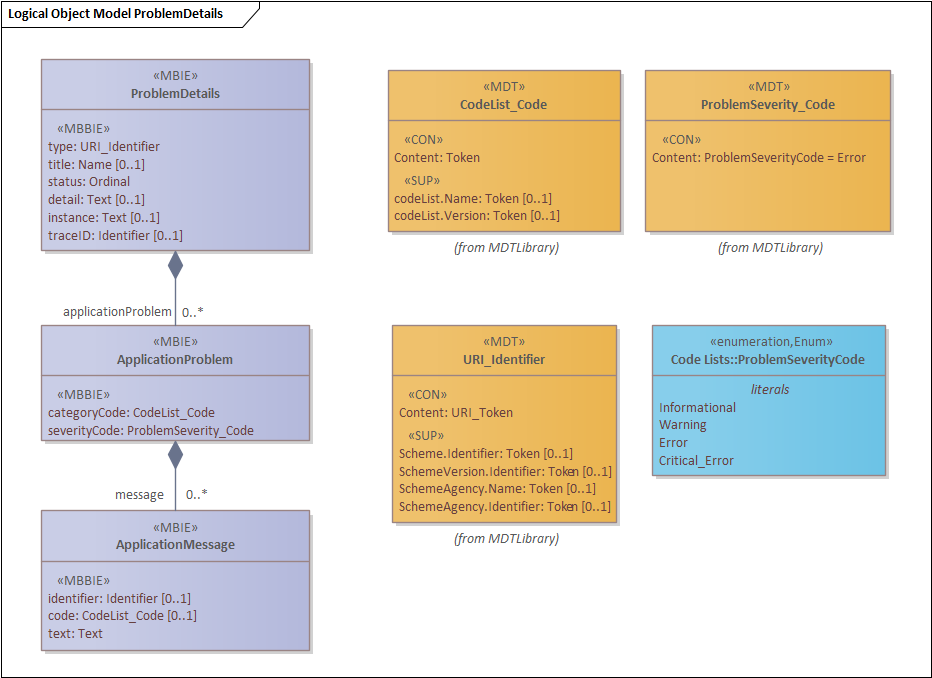 Standard model for problem details
The root of this model is a ProblemDetails class, which is essentially a one-to-one implementation of the model from the RFC-9457 standard. An additional field, traceID, has been added to facilitate faster and more efficient error tracing and to correlate related messages.
The traceID format is designed to be compatible with OpenTelemetry. It consists of the following components: \<version>-\<trace_id>-\<span_id>-\<trace_flags>
Example:
00-80e1afed08e019fc1110464cfa66635c-7a085853722dc6d2-01
TraceID structure:
| Component | Definition |
|---|---|
| version | Version of this trace format. |
| trace_id | All messages that are part of the same trace (i.e., a transaction) share the same trace_id, logically linking them together. |
| span_id | Within a trace, messages can be further linked using the span_id. Messages can also reference span_id as a parent identifier (e.g., "parent_id": "0x051581bf3cb55c13"), forming a hierarchical structure. |
| trace_flags | Indicators that are passed along with the trace. |
In principle, objects of the ProblemDetails type can be used directly as error responses, as they contain the relevant information needed for many generic errors. If additional details are required, an extension in the form of an array of ApplicationProblem objects can be used to provide feedback on application-specific errors.
Extension class: ApplicationProblem
An ApplicationProblem class can be used to report a specific category of errors. Each ApplicationProblem class can, in turn, include an optional list of ApplicationMessage classes, which are intended to provide additional details about the problem.
Attributes are defined as follows:
| Attribute | Definition |
|---|---|
| categoryCode | An enumeration defining an application-specific error category. Examples include: - Validation Errors - Processing Errors - Communication Errors |
| severityCode | Indicates the severity of the error, ranging from Informational, to Warning, to Error, and finally to Critical Error. |
Extension class: ApplicationMessage
Each category typically defines its own detail records, represented by objects of type ApplicationMessage, which include the following attributes:
| Attribute | Definition |
|---|---|
| identifier | A unique identifier (application-specific) for the error type. |
| code | An enumeration linking an application-specific error code to the identifier. Each ID has a corresponding unique error code. |
| text | The actual message text. |
Implicit Enumerations
The categoryCode and code attributes function as implicit enumerations (i.e., the schema does not explicitly define a fixed list of values). To still allow range validation, the enumeration type includes two additional attributes:
- codeListName = The name of the enumeration list used; this can also be a URI where the list can be retrieved.
- codeListVersion = The version of the enumeration list. This is optional if the name already includes the version (such as in a URI).
Example
Below is an example of a complete error response for a 400 Bad Request error. We assume that error code 912 is defined in the catalog as a code for specifying parameter validation errors and error code 661 is associated with the check ‘period start date must be earlier then period end date.’
The recommendation is to use type, title, and detail to provide as much generic, consistent, and reusable error information as possible (i.e., general error details), while using the ApplicationProblem extension record to return detailed information.
This approach allows for a relatively small set of error types to cover a wide variety of errors as shown in the example below:
{
  "type": "https://referentiegegevens.energiesysteem.nl/error-codes/id/912",
  "title": "Syntax errors in request",
  "status": 400,
  "detail": "Parameter validation error.",
  "instance": "urn:uuid:4017fabc-1b28-11e8-accf-0ed5f89f718b",
  "traceID": "00-80e1afed08e019fc1110464cfa66635c-7a085853722dc6d2-01",
  "applicationProblem": [
    {
      "categoryCode": "PARAMETER_VALIDATION_ERROR",
      "severityCode": "ERROR",
      "message": [
        {
          "identifier": "https://referentiegegevens.energiesysteem.nl/error-codes/id/661",
          "code": "PERIOD_VALIDATION_ERROR",
          "text": "Query parameter 'startDate' must be earlier then query parameter 'endDate'."
        },
        {
          "identifier": "https://referentiegegevens.energiesysteem.nl/error-codes/id/687",
          "code": "DOMAIN_VALIDATION_ERROR",
          "text": "Domain identifier is not owned by specified DSB'."
        },
      ]
    }
  ]
}